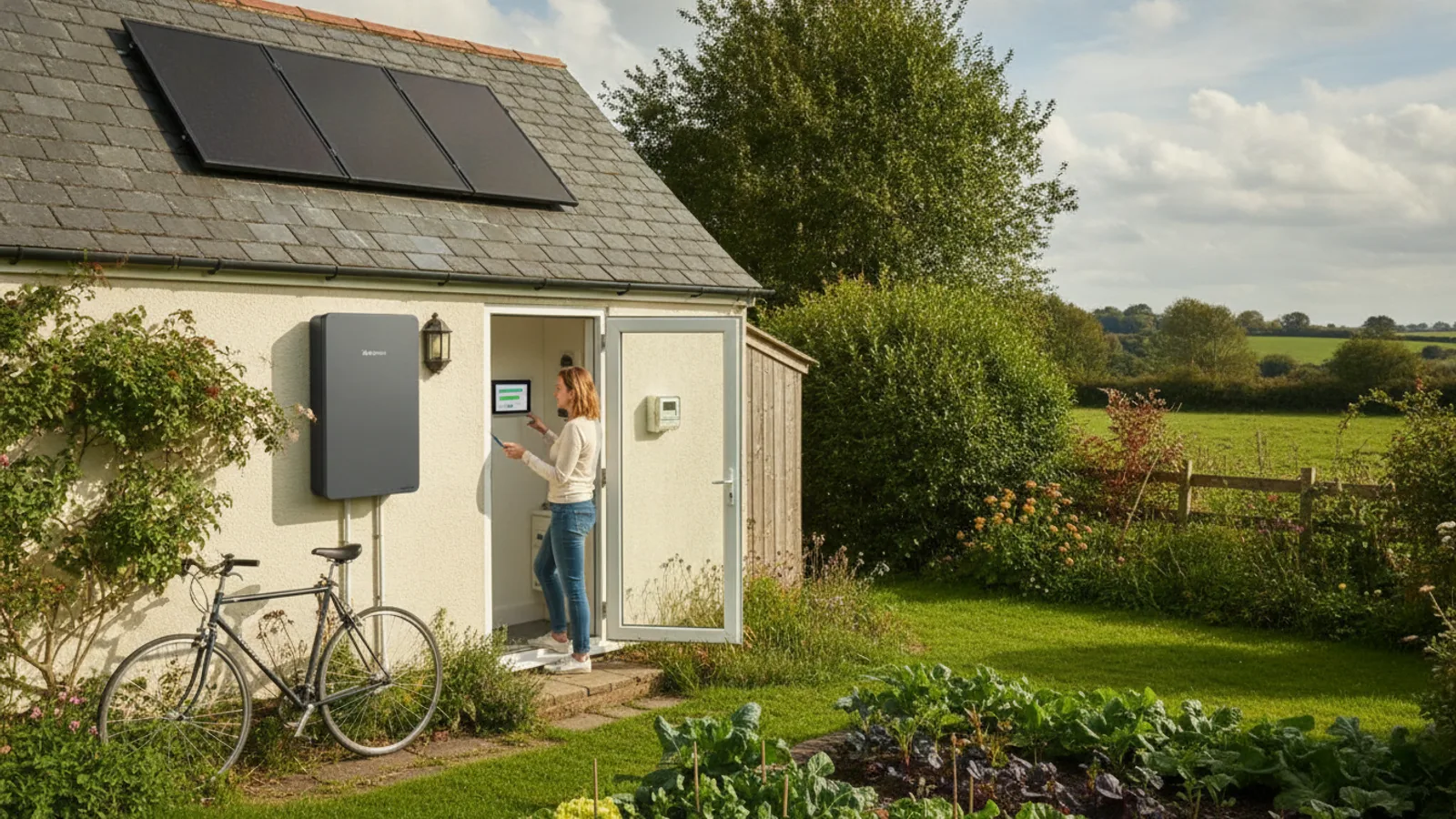
Solar Battery Storage For Small Homes
This guide walks you through the entire process of choosing and installing solar battery storage for a small home in the UK. If you have solar panels (or are planning to get them) and want to cut your electricity bills by storing your own green energy, this is for you. We cover everything from assessing your needs and understanding the costs to finding a trustworthy installer, helping you make a smart, sustainable investment.
Fast Answer
- Key Action: Assess your home's daily electricity use in kilowatt-hours (kWh).
- Ideal Size: A 2 kWh to 5 kWh battery is usually sufficient for smaller homes.
- Main Goal: Store surplus solar power generated during the day for use in the evening.
- Crucial Check: Only use an MCS certified installer for safety and compliance.
Before You Start
Proper planning is crucial for getting a system that truly saves you money. Before you start contacting installers, gather the following information and perform these essential checks. This preparation will empower you to ask the right questions and understand the quotes you receive.
What You Need
- Recent Electricity Bills: You'll need at least a few months' worth (ideally a full year) to calculate your average daily energy consumption in kilowatt-hours (kWh).
- Smart Meter Data (if available): Accessing your usage data via your supplier's app provides a much more detailed picture of when you use the most electricity.
- Existing Solar PV System Details: If you already have solar panels, find the paperwork. You need to know the system's peak capacity (kWp), the inverter make and model, and the installation date.
- A Rough Budget: Have an idea of what you are prepared to invest. This helps narrow down options and discussions with installers.
- Photos of Your Consumer Unit (Fuse Box) and Utility Meter: Potential installers will often ask for these to conduct a remote assessment.
Safety, Timing, or Context Checks
- Professional Installation is Non-Negotiable: Solar battery systems involve high-voltage direct current (DC) electricity. This is not a DIY job. Installation must be carried out by a qualified and certified electrician.
- MCS Certification: The Microgeneration Certification Scheme (MCS) is the UK standard for quality and safety in renewable energy installations. Using an MCS certified installer is essential for ensuring your system is safe, performs correctly, and is eligible for schemes like the Smart Export Guarantee (SEG).
- Smart Export Guarantee (SEG): If you have solar panels, you can sell surplus electricity back to the grid. A battery changes this dynamic. You'll store most of your surplus instead of exporting it. Understand how this affects your potential SEG payments.
- Planning Permission: For most small domestic battery systems installed indoors (like in a garage or utility room), planning permission is not required. However, if you plan a large outdoor installation, it's wise to check with your local planning authority.
Step-by-Step Instructions
Follow these steps methodically to move from initial curiosity to a fully operational solar battery system that's perfectly sized for your small home.
Assess Your Home's Energy Consumption
The most critical step is understanding how much electricity you actually use. A battery that's too big is a wasted investment, and one that's too small won't cover your needs. Look at your electricity bills for your annual or monthly "kWh used". Divide the annual figure by 365 to get a daily average.
For example, if you use 2,900 kWh per year, your daily average is about 8 kWh. Pay attention to seasonal differences; you'll use more in winter. If you have a smart meter, use its app to see your "half-hourly" usage. This will clearly show a usage spike in the morning and a larger one in the evening – this evening spike is exactly what you want the battery to cover.
Evaluate Your Solar Panel System
Your battery needs energy to store. This comes from the surplus electricity your solar panels generate. If you have an existing system, you need to know if it generates enough excess power to make a battery worthwhile.
Check your system's peak output, measured in kilowatts peak (kWp). A typical small home might have a 2-4 kWp system. On a sunny day, this system will generate more electricity than your home is using, especially if you are out. This surplus is what will charge your battery. If your existing system is very small (e.g., under 1.5 kWp) or heavily shaded, you may need to upgrade your panels to effectively charge a battery. If you're planning a new installation, your installer will design the panels and battery to work together perfectly.
Choose the Right Battery Size and Type
With your energy usage data, you can now consider battery specifications. The two key numbers are:
- Capacity (kWh): This is how much energy the battery can store. For a small home using 8 kWh per day, a battery with a usable capacity of 3-5 kWh is often a great starting point.
- Power Rating (kW): This is how much electricity the battery can deliver at once. A higher rating means it can power more appliances simultaneously. A typical rating of 2-3 kW is fine for most small homes.
Nearly all modern home batteries use Lithium-Ion chemistry, which is reliable and long-lasting. Also consider the battery's cycle life (how many times it can charge and discharge) and its Depth of Discharge (DoD), which tells you how much of its total capacity is usable. A good quality battery will have a DoD of 90-100%.
Understand the Financials: Costs vs. Savings
A solar battery is a significant financial decision. The total cost includes the battery unit, a compatible inverter (or a hybrid inverter if it's a new system), all wiring and mounting hardware, and the installation labour. For a small home system in the UK, you should budget for a fully installed cost in the range of £3,000 to £6,000, but prices fluctuate with demand and technology.
Your savings come from avoiding peak-rate electricity purchases from the grid. Instead of buying electricity every evening, you'll use the free solar energy you stored earlier. The time it takes for these savings to match the installation cost is the payback period. A reputable installer should provide you with a detailed savings calculation, but be realistic – payback periods are typically several years long.
Find and Shortlist Certified Installers
Now it's time to find the professionals. Do not simply search for "solar installers near me." Instead, use the official MCS Certified Installer finder online. This database lists all accredited companies in your area. Aim to create a shortlist of three to five reputable local and national companies.
Read online reviews, check their websites for case studies, and see how long they have been in business. A good installer will be transparent, knowledgeable, and happy to answer your preliminary questions without any hard-selling tactics.
Compare Quotes and Select Your Installer
Contact your shortlisted installers and request a detailed quote. A proper quote is more than just a price; it should be a comprehensive proposal that includes:
- An itemised breakdown of costs: battery model, inverter, other hardware, and labour.
- Clear details on the warranty for each component (usually 10 years for the battery) and the workmanship.
- A performance estimate showing expected energy storage and bill savings.
- The full technical specifications of the proposed battery.
- A clear timeline for installation.
Do not automatically accept the cheapest quote. Evaluate each one based on the quality of the components offered, the thoroughness of the proposal, and the professionalism of the company. A slightly more expensive quote with a better battery and a longer workmanship warranty can be a much wiser long-term investment.
Prepare for Installation Day
Once you've accepted a quote and set a date, there are a few things to do. The installation team will need clear and safe access to your consumer unit, your utility meter, and the location where the battery will be installed (often a garage, loft, or utility room). Ensure the area is tidy and free of obstructions.
Be aware that your home's electricity will need to be switched off for several hours during the installation. Plan accordingly. The entire process for a straightforward battery retrofit usually takes less than a full day. Ask your installer what to expect and if there's anything specific you need to do to prepare.
Commission and Monitor Your System
After the physical installation is complete, the engineer will "commission" the system. This involves configuring the software, testing all connections, and ensuring it communicates correctly with your solar panels and the grid. They must provide you with all the necessary handover documents, including MCS certificates and warranty information.
Crucially, they should also show you how to use the monitoring app on your phone or computer. This app is your window into the system, showing you how much energy your panels are generating, how much is going into the battery, and how much your home is using. Spend time getting familiar with it. Monitoring your system's performance is the best way to confirm it's delivering the savings you expected.
Quick Reference
| Situation | Use this | Why |
|---|---|---|
| My electricity bill says I use 7-9 kWh per day. | A 3-4 kWh battery. | This size is designed to cover typical evening peak usage, not the entire day's consumption, making it cost-effective. |
| I want to add a battery to my 5-year-old solar panels. | An AC-coupled battery system. | AC-coupled systems are designed to "bolt on" to any existing solar installation easily, without needing to replace the original solar inverter. |
| My main priority is having power during a blackout. | A system with backup or EPS capability. | Standard grid-tied systems shut down during a power cut for safety. You must specify that you need an Emergency Power Supply (EPS) function, which may cost more. |
| I'm getting solar panels and a battery installed together. | A DC-coupled or hybrid system. | These systems use a single, smart "hybrid" inverter to manage both the panels and the battery, which is slightly more efficient than two separate units. |
Common Problems When You Install Solar Battery Storage
Problem: The battery isn't fully charging on sunny days.
This can happen for a few reasons. First, check your home's daytime energy consumption via your monitoring app. If you're running high-power appliances like a washing machine and dishwasher during peak sun, that energy is being used directly, leaving less surplus to charge the battery. Second, your solar PV array might be slightly undersized for the battery's capacity, especially on days that aren't perfectly clear. Finally, temporary issues like a dirty panel surface or new shading from a growing tree can reduce output.
Problem: My electricity bills haven't dropped as much as I expected.
The biggest factor here is often your electricity tariff. To maximise savings, you should be on a tariff that has a significant price difference between peak and off-peak rates, such as an Economy 7 or a dedicated time-of-use tariff. This makes the "free" energy from your battery far more valuable. Also, review your usage habits. If your consumption has increased since the battery was installed, your savings might be offset by using more total energy.
Problem: The monitoring app is showing confusing data or has stopped working.
First, try the basic IT solution: restart the app and check your home's Wi-Fi network is working correctly, as the system needs internet to report data. If the problem persists, don't hesitate to contact your installer. Part of their service is providing post-installation support, and they can diagnose whether it's a simple connectivity issue or a deeper system fault.
Advanced Tips for Solar Battery Storage
Once your system is up and running, you can use these strategies to squeeze even more value from your investment.
Embrace Time-of-Use Tariffs
This is the single most powerful tool for a battery owner. Tariffs like Octopus Agile or Economy 7 offer incredibly cheap electricity for a few hours overnight. In winter, when solar generation is low, you can configure your battery to charge from the grid during this cheap period. This means you still avoid using expensive peak-rate electricity in the evening, even when you can't fill the battery from the sun. Your installer can help you set this up.
Understand AC vs. DC Coupling
When getting quotes, you'll hear these terms. An AC-coupled system is best for retrofitting to existing solar panels. It uses its own inverter and works independently of your solar inverter. A DC-coupled system (or hybrid system) is ideal for new installations. It uses one inverter to handle both the panels and the battery. The DC power from the panels can charge the DC battery more efficiently as it requires fewer conversions. This is a technical point, but understanding it helps you evaluate quotes better.
Plan for Future Upgrades
Your energy needs might change. You might buy an electric vehicle (EV) or replace a gas hob with an induction one. When choosing a battery system, ask about its modularity. Some brands allow you to add extra battery units later to increase your storage capacity. Opting for a modular system gives you future-proof flexibility without having to over-invest today.
Solar Battery Storage For Small Homes FAQ
How much does a solar battery cost for a small UK home?
As of late 2023 / early 2024, a fully installed small battery system (e.g., 3-5 kWh) typically costs between £3,000 and £6,000. This price includes the battery, inverter, and all installation work. Prices vary based on the brand, complexity of the installation, and location.
Is solar battery storage worth it for a small home?
It's becoming increasingly worthwhile. With high electricity prices, the ability to store and use your own free energy provides significant savings and energy independence. The financial viability depends on your specific energy usage, the cost of the system, and future electricity prices. A good installer will provide a personalised payback calculation.
How long do solar batteries last?
Most modern lithium-ion home batteries come with a 10-year warranty. Their expected lifespan is generally between 10 and 15 years. Lifespan is also measured in "cycles" (a full charge and discharge), and most are rated for 6,000 to 10,000 cycles, which is more than enough for over a decade of daily use.
Can I go completely off-grid with a battery?
For a typical home in the UK, going completely off-grid is impractical and extremely expensive. It would require a vast solar panel array and a massive battery bank to get through the dark British winters. A grid-connected system is the most sensible and cost-effective solution, giving you the best of both worlds.
Final Checklist for Solar Battery Storage
Before signing any contract, run through this final checklist to ensure you've covered all the bases for your small home's solar battery project.
- Calculated your average daily electricity usage in kWh from bills or a smart meter.
- Assessed your current (or planned) solar panel system's size and surplus generation potential.
- Determined a suitable battery capacity for your needs, likely in the 2-5 kWh range.
- Received at least three detailed, itemised quotes from different installers.
- Verified that every installer on your shortlist holds current MCS certification.
- Confirmed the warranty period for the battery, the inverter, and the installation workmanship.
- Understood the estimated payback period and the assumptions used to calculate it.
- Discussed time-of-use tariff optimisation and backup power options with your preferred installer.
- Read and understood the full terms of the contract before signing.


