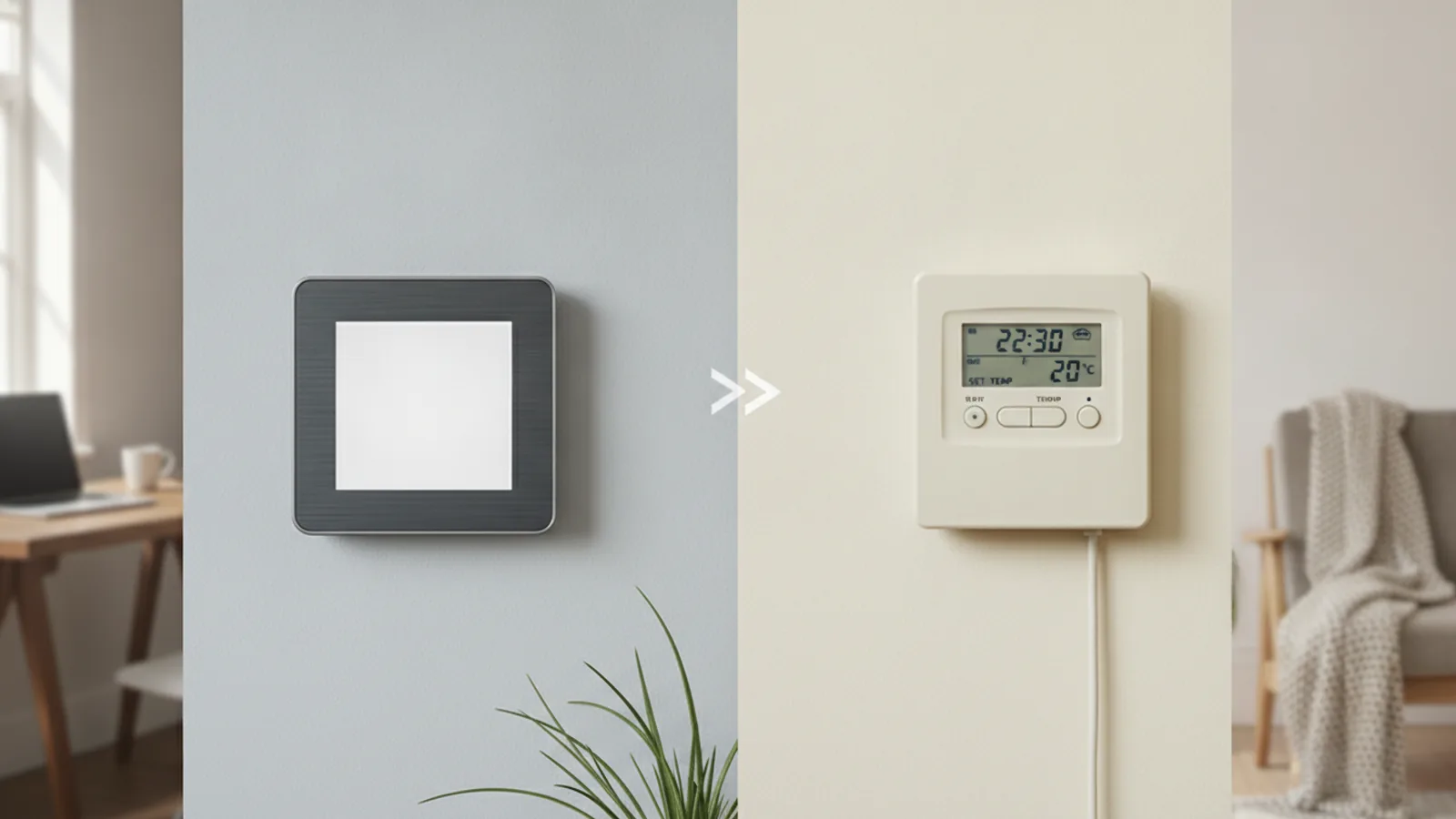
Smart Thermostat vs Programmable Thermostat: Which Should You Choose?
Head-to-head comparison
Overall winner: Smart Thermostat for its superior energy-saving potential and adaptability to modern life.
For most UK homes in 2026, a smart thermostat is the superior investment. It learns your household's patterns, adapts to changes automatically, and offers remote control for ultimate convenience and efficiency. However, a programmable thermostat remains a solid, budget-friendly choice for those with highly consistent weekly schedules who prefer a simple, set-and-forget device without connectivity.
Option A
Smart Thermostat
- Best fit: Households with variable schedules seeking maximum savings.
- Strength: Learns routines, remote app control, and detailed energy reports.
- Tradeoff: Higher upfront cost and requires a stable Wi-Fi connection.
Option B
Programmable Thermostat
- Best fit: Budget-conscious buyers with a fixed 9-to-5 weekly routine.
- Strength: Affordable, reliable, and simple to operate once set up.
- Tradeoff: Inflexible to schedule changes and lacks smart features.
Head-to-Head Scorecard
Choosing the right thermostat is a critical step in managing your home's energy consumption and comfort. For years, the programmable thermostat was the standard for moving beyond a simple manual dial. But the rise of the smart home has introduced a more intelligent option. This guide breaks down the practical differences between a smart thermostat and a programmable thermostat to help you decide which is the right investment for your household's budget and lifestyle.
This comparison is based on extensive product research, analysis of official specifications, and patterns in public user feedback. We have not performed direct hands-on testing of every model.
Smart Thermostat vs Programmable Thermostat: Key Differences
At their core, both devices aim to control your heating more efficiently than a manual thermostat. The fundamental difference lies in *how* they achieve this and how much input they require from you.
- A programmable thermostat operates on a fixed schedule that you manually input. You tell it what temperature to be at specific times on specific days (e.g., 20°C from 7 am to 9 am on weekdays). It follows these instructions rigidly until you manually override it or reprogram it. It's a simple, effective tool for homes with predictable routines.
- A smart thermostat goes several steps further. It connects to your home's Wi-Fi, allowing you to control it from a smartphone app anywhere in the world. More importantly, it learns your habits over time, building a schedule automatically. It also uses additional data points like your phone's location (geofencing) to know when you're home or away, and can even pull local weather data to heat more efficiently.
Think of it this way: you have to actively *manage* a programmable thermostat, whereas a smart thermostat aims to *manage your comfort for you*. This distinction is the source of all the key differences in cost, convenience, and energy-saving potential.
Measurement
Routine Fit
How well a thermostat fits your daily life is crucial. If it's difficult to manage, its energy-saving benefits can be quickly negated by manual overrides.
A programmable thermostat excels if your life runs like clockwork. Common types include 7-day models (unique schedules for each day), 5-2 models (one schedule for weekdays, another for weekends), and 5-1-1 models (weekdays, Saturday, Sunday). If you leave for work and return home at the same time every weekday, this system is perfectly adequate. The problem arises with any deviation. If you work from home unexpectedly, have a day off, or go on holiday, you must remember to manually adjust the thermostat. If you forget, you'll be wasting energy heating an empty house or returning to a cold one.
A smart thermostat is built for the unpredictability of modern life. Its learning algorithm tracks your adjustments and starts to anticipate your needs. Geofencing is a standout feature: the thermostat uses your smartphone's location to automatically lower the temperature when the last person leaves the house and turn it back on as the first person heads home. This "set and truly forget" automation means it adapts without you needing to think about it, ensuring you're never wasting money heating an empty home.
Measurement
Energy Savings Potential
The primary reason to upgrade from a manual thermostat is to reduce your energy bills. Both types offer savings, but their potential differs significantly.
Programmable thermostats can cut energy use, but their effectiveness is entirely dependent on you. You must program an efficient schedule and stick to it. Research has shown that many users struggle to program them correctly or simply use the "hold" function constantly, defeating the purpose. When used perfectly, they offer good savings over a manual thermostat. However, their real-world savings are often less than their theoretical potential.
Smart thermostats are designed to maximise savings automatically. By learning your schedule, using presence detection, and adjusting for weather conditions, they eliminate the human error that limits their programmable cousins. Leading brands like Nest claim their thermostats can save users an average of 10-12% on heating bills. Furthermore, they provide detailed energy reports in their apps, showing you exactly when you're using the most energy and offering tips to reduce it further. Some can even integrate with utility company schemes to shift energy use away from peak, expensive times.
Measurement
Ease of Use
Technology is only useful if it's easy to interact with. Here, the difference between the two types is stark.
Programmable thermostats are notoriously fiddly. They typically feature a small, basic LCD screen and a series of confusing buttons. Setting up a weekly schedule can be a tedious process of pressing 'up', 'down', 'next', and 'confirm' dozens of times. While you only need to do it once in theory, any change requires you to repeat the process.
Smart thermostats are designed around the modern smartphone. Their primary interface is a clean, intuitive app. Adjusting the temperature is as simple as sliding a dial on your screen. Changing a schedule is a simple drag-and-drop affair. You can control your heating from the sofa, from work, or from the airport. Many also support voice commands via Amazon Alexa, Google Assistant, or Apple's Siri, allowing you to simply say, "Set the heating to 21 degrees." This level of accessibility and convenience is unmatched.
Measurement
Value
Value isn't just about the initial price; it's about the return on your investment over time.
A programmable thermostat is the undisputed winner on upfront cost. You can buy a reliable model for as little as £20 to £60. It's a small, one-time purchase that will start saving you money immediately compared to a manual thermostat, provided you program it well. Its long-term value comes from this low barrier to entry.
A smart thermostat is a significant investment, with popular models from brands like Google Nest, Hive, and Tado costing between £150 and £250, sometimes more if professional installation is required. However, its value proposition is based on a faster payback period through greater energy savings. If a smart thermostat saves you an extra £80 per year on heating compared to a poorly managed programmable one, it could pay for its initial cost in just 2-3 years. After that, the continued savings represent a better long-term return. This doesn't even factor in the added value of comfort and convenience.
Measurement
Buyer Confidence
Confidence in your purchase comes from reliability, simplicity, and knowing the product will work as intended for years to come.
Programmable thermostats are a mature, proven technology. They are self-contained electronic devices that don't rely on any external services. There is no app to update, no server that can go down, and no Wi-Fi password to re-enter. They don't collect your data. For buyers who prioritise simplicity and offline reliability, a programmable thermostat is a fortress of predictability. It does one job, and it does it reliably for a decade or more.
Smart thermostats, by their very nature, introduce more complexity and points of potential failure. They require a stable internet connection to function correctly. If your Wi-Fi goes out, you lose remote control and smart features (though you can usually still adjust it manually on the device). They depend on the manufacturer's cloud servers and app support. This raises valid concerns about long-term support, data privacy, and security. While major brands have excellent track records, you are placing your trust in a connected service, not just a standalone device.
Choose Smart Thermostat If...
- Your household has an irregular or unpredictable schedule.
- You want to achieve the maximum possible energy savings on your heating bills.
- You are comfortable using smartphone apps and enjoy smart home technology.
- You want the ability to control your heating remotely when you are away from home.
- You find detailed energy usage reports and saving suggestions valuable.
- You are willing to make a larger upfront investment for long-term returns and convenience.
Choose Programmable Thermostat If...
- You and your family follow a very consistent, fixed weekly routine.
- Your primary concern is the lowest possible upfront cost.
- You prefer simple, offline technology and do not want another app on your phone.
- You have no need or desire to adjust your heating when you're not at home.
- You are concerned about the data privacy and security of connected home devices.
- You have an unreliable internet connection.
Final Verdict: Smart Thermostat vs Programmable Thermostat
For the vast majority of households, the Smart Thermostat is the clear winner and the better investment in 2026. While the upfront cost is higher, the superior convenience, adaptability to real-life schedules, and greater potential for energy savings provide a long-term value that is hard to ignore. The ability to control your heating from anywhere and let the device optimise itself is a game-changer for both comfort and your wallet.
However, that does not make the Programmable Thermostat obsolete. It remains an excellent, cost-effective choice for a specific user: someone on a tight budget with a rock-solid daily routine. If you leave and return at the same time every day and don't want the complexity of a connected device, a programmable thermostat will serve you well and still deliver significant savings over a basic manual one. It is a reliable workhorse, but a smart thermostat is a strategic upgrade.
Smart Thermostat vs Programmable Thermostat: Which Should You Choose? FAQ
How much can you really save with a smart thermostat?
Major manufacturers like Google Nest and Tado cite average savings of 10-15% on heating bills. The exact amount depends heavily on your previous habits, your home's insulation, and how you use the smart features. The savings come from eliminating waste, such as heating an empty house or optimising boiler firing times.
Are smart thermostats difficult to install?
Installation difficulty is similar to that of a programmable thermostat. If you are comfortable with basic wiring and following instructions, you can often DIY the installation in under an hour. However, due to the need to work with your home's electrical system, many people opt for professional installation for peace of mind. Many smart thermostat brands offer bundles that include professional installation.
Do smart thermostats work without Wi-Fi?
Yes, but only as a basic thermostat. If your internet connection goes down, you can still manually adjust the temperature on the device itself. However, you will lose all "smart" functionality, including app control, scheduling, learning features, and geofencing, until the connection is restored.
Is a programmable thermostat still a good choice in 2026?
Absolutely, for the right person. If your budget is the primary driver and your schedule is highly predictable, a programmable thermostat is a perfectly logical and effective energy-saving tool. It's a significant upgrade from a manual thermostat at a fraction of the cost of a smart one.
What's the difference between a smart thermostat and smart thermostatic radiator valves (TRVs)?
A smart thermostat controls the entire heating system for your home, telling the boiler when to turn on and off. Smart TRVs are installed on individual radiators and allow you to create different temperature "zones" in your home. For example, you can heat the living room in the evening without heating the empty bedrooms. The two systems work best together for maximum efficiency and control.


