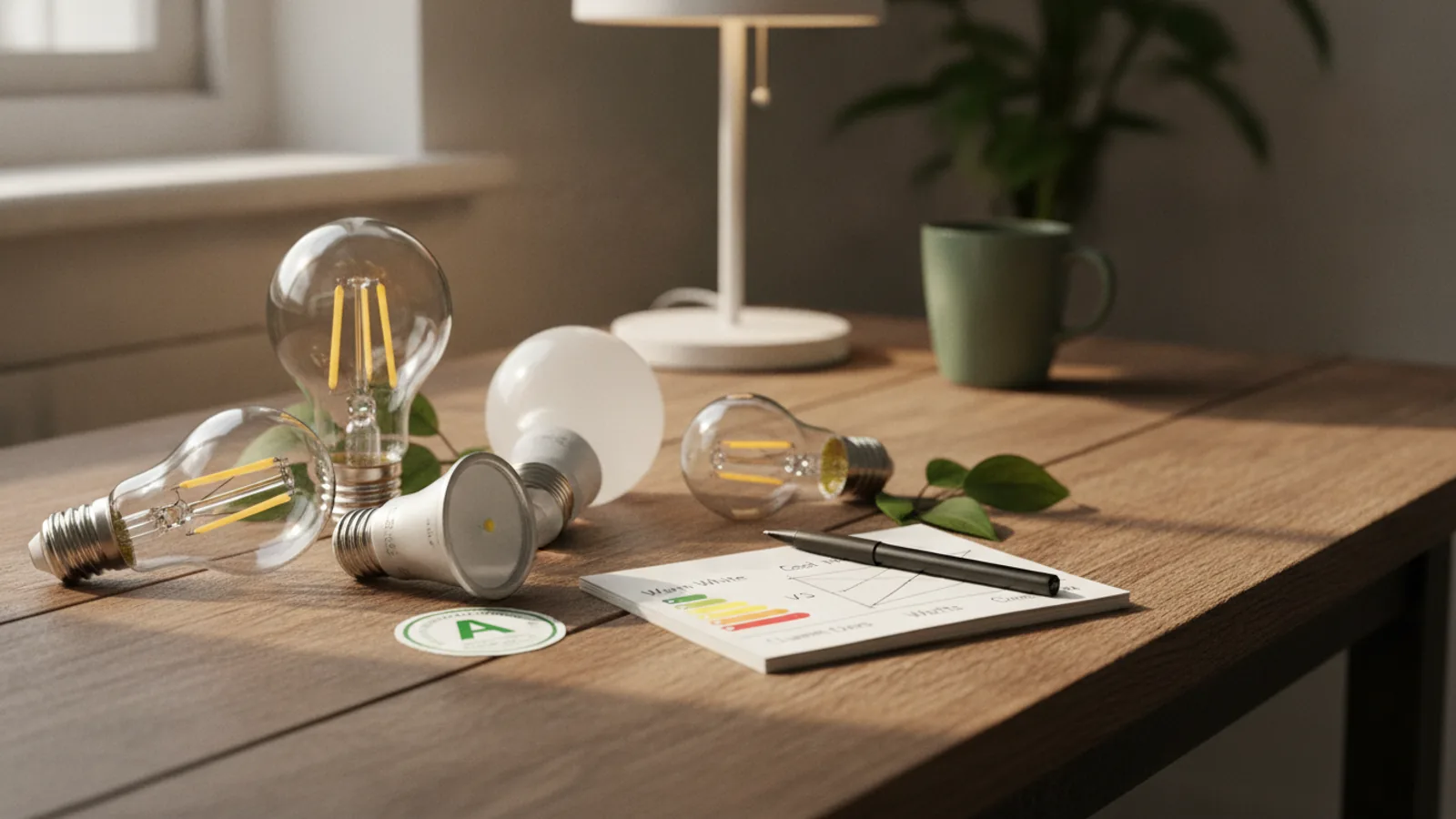
How To Choose Led Bulbs
Switching to LED light bulbs is one of the quickest ways to reduce your home's energy consumption and lower your electricity bills. But with so many options for brightness, colour, and fittings, choosing the right one can feel confusing. This guide walks you through everything you need to know, from understanding lumens and Kelvin to picking the correct fitting for your lamps and fixtures. Follow these steps to confidently select the perfect energy-saving LED bulb for any room in your house.
Fast Answer
- Brightness: Look for lumens (lm), not watts. 800 lm replaces a classic 60W bulb.
- Colour: Check the Kelvin (K) rating. 2700K is warm white (cosy), 4000K is cool white (tasks).
- Fitting: Match the base of your old bulb. The most common in the UK are B22 (bayonet) and E27 (screw).
- Dimmable: Only buy bulbs marked 'dimmable' if you have a dimmer switch.
Before You Start
- Your old light bulb: Have one handy to check its fitting, shape, and wattage (for brightness comparison).
- Your room's purpose: Know if you need cosy ambient light (living room) or bright task lighting (kitchen).
- Your light switch type: Check if the light is controlled by a standard on/off switch or a rotary/slider dimmer.
Step-by-Step Instructions
Identify Your Bulb Fitting Type
The first and most critical step is to determine the type of base your light fixture requires. The easiest way to do this is to carefully remove the old bulb (after turning the power off) and inspect its base. In the UK, you will most commonly encounter two types for standard lamps and ceiling pendants.
- B22 / Bayonet Cap (BC): This fitting has a smooth base with two small pins that stick out from the sides. You push it into the socket and twist it to lock it in place.
- E27 / Edison Screw (ES): This is a larger threaded screw base, which you simply screw into the socket until it's snug.
You may also find smaller versions, like the E14 Small Edison Screw (SES) for decorative lamps or the B15 Small Bayonet Cap (SBC). For spotlights, the most common fitting is the GU10, which has two short, thick pins that you push in and twist.
Choose the Right Brightness in Lumens
For decades, we've associated brightness with watts. With hyper-efficient LEDs, watts are no longer a useful measure of brightness; they only tell you how much energy the bulb consumes. The correct measure for brightness is now lumens (lm).
To replace an old incandescent bulb, use this as a rough guide. Look for the lumen rating on the LED bulb's packaging.
- To replace a 25W bulb, look for about 250 lumens.
- To replace a 40W bulb, look for about 450 lumens.
- To replace a 60W bulb, look for about 800 lumens.
- To replace a 75W bulb, look for about 1,100 lumens.
- To replace a 100W bulb, look for about 1,600 lumens.
Select the Correct Colour Temperature in Kelvin
Beyond brightness, the colour of the light itself dramatically affects the mood of a room. This is measured on the Kelvin scale (K). Lower Kelvin values produce a warmer, yellower light, while higher values produce a cooler, bluer light.
- Warm White (2200K - 3000K): This is the cosy, yellowish glow we associate with traditional incandescent bulbs. It's perfect for creating a relaxing and inviting atmosphere in living rooms, bedrooms, and dining areas. 2700K is the most common and popular choice for homes.
- Cool White (3100K - 4500K): This light is more neutral and white, similar to the light on a slightly overcast day. It's excellent for task lighting where you need clarity and focus, such as in kitchens, bathrooms, home offices, and garages. 4000K is a typical choice for these areas.
- Daylight (4600K - 6500K): This is a very bright, almost blue-tinted light that mimics natural daylight. It's intense and best used for utility areas, workshops, or specialised task lighting for reading or crafts where maximum colour accuracy is needed.
The Kelvin rating will be clearly printed on the bulb's packaging. Choosing the right one is purely a matter of function and personal preference.
Pick a Suitable Bulb Shape
LEDs come in all the familiar shapes of old bulbs. The shape is important not just for fitting into your lamp, but also for how it distributes light. An "omnidirectional" bulb casts light in all directions, while a directional bulb focuses it.
- GLS (General Lighting Service): The classic pear shape, designed for omnidirectional light. It's the standard for most table lamps and ceiling fixtures.
- Candle and Golf Ball: Smaller, decorative shapes often used in chandeliers, wall sconces, or smaller lamps where a standard GLS bulb would be too large.
- Spotlight (GU10, MR16): Designed to cast a directional beam of light. These are used in recessed ceiling fixtures and track lighting. Pay attention to the "beam angle" here—a narrow angle (e.g., 36°) is for highlighting, while a wide angle (e.g., 60°+) provides more general illumination.
- Filament Style: These mimic the look of old Edison bulbs with visible "filaments." They are great for decorative fixtures where the bulb itself is part of the aesthetic.
Check for Dimmability
This is a common pitfall. Standard LED bulbs are not dimmable. If you install a non-dimmable LED on a circuit with a dimmer switch, it will likely flicker, buzz, or fail to work at all. This can also damage the bulb and the switch over time.
If your light fitting uses a dimmer, you must buy a bulb that is clearly marked as "Dimmable" on the packaging. Be aware that even with a dimmable bulb, older "leading edge" dimmer switches designed for high-wattage incandescent bulbs may not perform well. For best results, you may need to upgrade the switch itself to a modern "trailing edge" or LED-compatible dimmer.
Consider the Colour Rendering Index (CRI)
While not a primary concern for every room, the Colour Rendering Index (CRI) is a measure of how accurately a light source reveals the true colours of objects. The scale goes up to 100, which represents the perfect colour accuracy of natural sunlight.
For general home use, an LED bulb with a CRI of 80 or more is perfectly adequate. However, for certain areas, a higher CRI can make a noticeable difference. Consider a bulb with a CRI of 90+ for kitchens (to see the true colour of food), bathrooms (for applying makeup), or home offices and art studios where colour accuracy is important.
Read the Energy Label
All light bulbs sold in the UK have an energy efficiency label. The scale was updated in recent years and now runs from A (most efficient) to G (least efficient). Almost all LED bulbs will fall into the higher categories.
The label also provides useful information at a glance, including the energy consumption in kilowatt-hours per 1,000 hours of use (kWh/1000h). This figure makes it easy to compare the running costs of different bulbs. A lower kWh/1000h value means a cheaper bulb to run. There's also a QR code you can scan to see more detailed product information online.
Quick Reference
| Room / Situation | Recommended Brightness (Lumens) | Recommended Colour (Kelvin) | Why |
|---|---|---|---|
| Living Room | 800 - 1600 lm total | 2700K (Warm White) | Creates a cosy, relaxing, and inviting atmosphere for socialising or watching TV. |
| Kitchen (Main & Task) | 800 lm (main) + 450 lm (task) | 4000K (Cool White) | Provides clean, bright light for food preparation and cooking, ensuring safety and visibility. |
| Bedroom | 450 - 800 lm | 2700K (Warm White) | Promotes relaxation and helps wind down before sleep. Avoids harsh, blue-toned light. |
| Reading Lamp | 450 lm | 3000K - 4000K | A focused, neutral light that reduces eye strain without being too harsh or stimulating. |
| Bathroom | 800 lm+ | 4000K - 5000K | Bright, clean light is essential for grooming tasks. Ensure the fitting is IP-rated for moisture. |
| Home Office | 1100 lm | 4000K - 5000K | A neutral-to-cool white light that aids concentration and reduces eye fatigue during work. |
Common Problems When You Choose Led Bulbs
Problem: My new LED bulb is flickering or buzzing.
This is almost always caused by an incompatibility with a dimmer switch. If the bulb is on a dimmer circuit, ensure you have bought a "dimmable" LED. If you have, the dimmer switch itself is likely an older "leading-edge" model. You will need to replace the switch with a modern "trailing-edge" or LED-compatible dimmer to solve the problem.
Problem: The light feels too clinical or too yellow.
This is an issue with the colour temperature (Kelvin). If the light feels harsh and blueish ("clinical"), you've likely chosen a bulb with a high Kelvin rating (4000K+). If it's too yellow, you may have chosen an "extra warm white" bulb (2200K). For a standard, cosy feel, look for 2700K. For a clean, neutral white, choose 4000K.
Problem: The bulb doesn't seem as bright as my old one.
You probably compared watts instead of lumens. An old 60W incandescent bulb is much brighter than a 6W LED bulb, even though the number seems smaller. The correct comparison is lumens. An old 60W bulb produces about 800 lumens, so you need an LED bulb with a similar rating. Always check the lumen count on the box.
Problem: The LED bulb burned out much faster than promised.
The primary enemy of an LED's lifespan is heat. If the bulb was installed in a fully enclosed or poorly ventilated fixture (like some glass globe fittings or recessed ceiling cans), heat can build up and cause the sensitive electronics to fail prematurely. Ensure there is some airflow around the bulb, or look for LEDs specifically rated for use in enclosed fixtures.
Advanced Tips for how to choose led bulbs
Once you've mastered the basics, these tips can help you fine-tune your home lighting for even better results and value.
- Explore Smart Bulbs: For the ultimate in control, consider smart LED bulbs. They connect to your home Wi-Fi and can be controlled via an app or smart speaker. You can change their brightness, colour, and set schedules. While more expensive upfront, they offer unparalleled flexibility, especially in multi-use rooms.
- Check the Beam Angle for Spotlights: When choosing GU10 or other spotlight bulbs, the beam angle is crucial. A narrow angle (e.g., 25-40 degrees) is perfect for accent lighting, like highlighting a piece of art. A wider angle (60-120 degrees) is better for general illumination, spreading the light over a larger area like a kitchen worktop.
- Look for the Warranty: Reputable LED bulb manufacturers stand by their products. A good quality bulb will often come with a 2, 3, or even 5-year warranty. This is a good indicator of quality and gives you peace of mind that your investment will last.
- Buy Multi-Packs for Consistency: If you're replacing multiple bulbs in one room (e.g., in a ceiling fixture with several sockets), buy them all from the same multi-pack. This helps to ensure that the brightness and colour temperature are perfectly consistent across all the bulbs.
How To Choose Led Bulbs FAQ
Why are LED bulbs so much better than old incandescent or halogen bulbs?
There are three main reasons. Energy Efficiency: LEDs use up to 90% less electricity to produce the same amount of light, saving you significant money on your bills. Lifespan: A typical LED can last 15,000 to 25,000 hours, which can be over 15 years of average use. This is 10-25 times longer than old bulbs. Environmental Impact: Their efficiency reduces carbon emissions, and unlike CFLs (compact fluorescents), they contain no toxic mercury.
Can I put an LED bulb in any light fitting?
Mostly, yes. As long as you match the fitting type (e.g., B22, E27) and the bulb's physical shape fits inside the fixture, it will work. The main exceptions are fully enclosed fixtures that trap heat (which shortens the bulb's life) and circuits with incompatible dimmer switches.
Do I need a special dimmer switch for LEDs?
Yes, for the best performance. Even if you use a "dimmable" LED bulb, old dimmer switches were designed for the high power draw of incandescent bulbs. They often don't work well with low-power LEDs, causing flickering. To fix this, you need to replace the switch with an LED-compatible "trailing edge" dimmer.
Is it worth paying more for a well-known brand?
In general, yes. While cheap, unbranded bulbs are tempting, established brands often offer better reliability, more accurate colour rendering (higher CRI), consistent brightness, and longer warranties. The small extra cost upfront is often worth it for the better performance and longevity.
Final Checklist for how to choose led bulbs
- Identified the correct fitting (e.g., B22, E27, GU10) from your old bulb.
- Chosen the right brightness in lumens to replace the old wattage.
- Selected the appropriate colour temperature in Kelvin for the room's atmosphere.
- Confirmed whether you need a standard or a dimmable bulb.
- Picked a bulb shape that fits the fixture and directs light as needed.
- Checked the energy label to compare running costs.
- (Optional) Considered a high CRI for colour-critical areas and the beam angle for spotlights.


