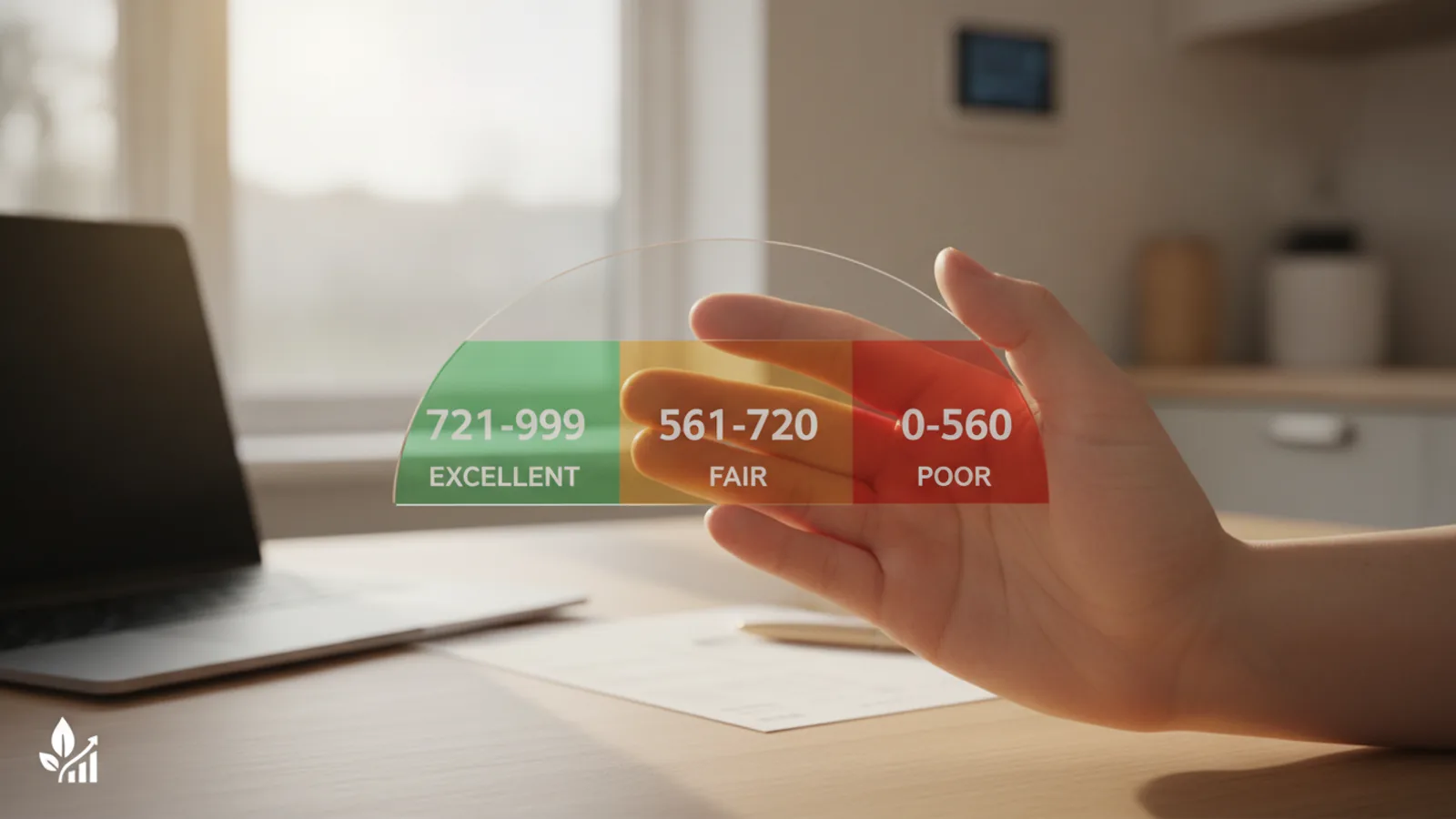
Credit Score Ranges
Understanding UK credit score ranges is the first step towards unlocking better financing for your eco-home projects. A strong score can mean lower interest rates on loans for solar panels, heat pumps, or insulation, saving you thousands over the long term. This guide explains how to check your credit score, interpret the different ranges from the UK's main credit reference agencies, and use this knowledge to improve your financial standing for a more sustainable future.
Fast Answer
- Main Agencies: Experian, Equifax, and TransUnion are the three main UK credit reference agencies.
- Different Scales: Each agency uses a different scoring range, so your score will vary between them.
- Experian Score: Ranges from 0-999.
- Equifax Score: Ranges from 0-1000.
- TransUnion Score: Ranges from 0-710.
Before You Start
- Proof of Identity: You'll need a valid form of ID like a passport or driving licence to verify your identity online.
- Address History: Have your addresses for the past 3-6 years ready, including postcodes.
- Financial Details: Some services may ask for details of a bank account or credit card to confirm you are who you say you are (this is usually a 'soft search' and won't affect your score).
- Secure Internet Connection: Always use a private, secure connection when accessing sensitive financial information.
How to Check and Understand Your Credit Score Ranges
Step 1: Understand Why Your Credit Score Matters for Eco-Savings
Before diving into the numbers, it's crucial to grasp the connection between your credit score and your sustainable living goals. Lenders use your credit score to gauge how risky it is to lend you money. A higher score indicates lower risk, which often translates to a better chance of being approved for credit and, importantly, access to lower interest rates.
For homeowners, this is key. Whether you're considering a loan for double-glazing, a grant-topped-up heat pump installation, or financing for an electric vehicle charger, a better credit score can significantly reduce the overall cost. A lower interest rate on a £10,000 loan for solar panels could save you hundreds or even thousands of pounds over the loan's lifetime. Understanding your credit score range is the first practical step in this financial-sustainability journey.
Step 2: Identify the Three Main UK Credit Reference Agencies
In the UK, your financial data is collected and managed by three main Credit Reference Agencies (CRAs). It's vital to know them because lenders may check with one, two, or all three when you apply for credit. Each one gets slightly different information from lenders, meaning your report and score will differ across the three platforms.
- Experian: One of the largest and most well-known CRAs in the UK. Their score is out of 999.
- Equifax: Another major player, providing data to a wide range of lenders. Their score is out of 1000 (previously 700).
- TransUnion: Formerly known as Callcredit, this is the third major agency. Their score is out of 710.
You don't have one single "universal" credit score. You have at least three, and they are all important. For a complete picture of your financial health, you should aim to check your report with all three agencies.
Step 3: Access Your Credit Reports and Scores
You have a legal right to see the information the agencies hold on you. There are several ways to do this, many of which are free.
Free Services: Several popular and reputable services allow you to see your score and report for free, forever. They make money by showing you offers for financial products you're likely to be accepted for.
- To see your TransUnion report, you can use services like Credit Karma or TotallyMoney.
- To see your Experian report, you can sign up for a free Experian account or use the MoneySavingExpert Credit Club.
- To see your Equifax report, you can use ClearScore.
Directly from the Agencies: You can also sign up for free or paid subscription services directly on the Experian, Equifax, and TransUnion websites. These often offer more detailed insights and score-tracking tools.
Step 4: Interpret Your Score Within Each Agency's Range
Once you have your score, the next step is to understand what it means. Since each agency uses a different scale, a score of "600" can mean very different things. Lenders also have their own criteria, but the bands below give a general idea of how they view your score.
Experian (0-999)
- Excellent: 961-999
- Good: 881-960
- Fair: 721-880
- Poor: 561-720
- Very Poor: 0-560
A score in the 'Good' or 'Excellent' range gives you the best chance of acceptance for most products and access to the most competitive interest rates.
Equifax (0-1000)
- Excellent: 811-1000
- Very Good: 671-810
- Good: 531-670
- Fair: 439-530
- Poor: 0-438
Equifax uses a five-band system. Again, aiming for 'Good' and above is the target for securing cost-effective finance.
TransUnion (0-710)
- Excellent: 628-710
- Good: 604-627
- Fair: 566-603
- Poor: 551-565
- Very Poor: 0-550
Note that the 'Good' and 'Excellent' bands for TransUnion are narrower than for the other agencies. Even small changes can move you between bands.
Step 5: Analyse the Key Factors Affecting Your Score
Your credit report will show you the "why" behind your score. Look for the sections that detail the positive and negative factors. Common elements include:
- Payment History: This is one of the biggest factors. A history of making payments on time for bills, credit cards, and loans will boost your score. Late or missed payments will lower it.
- Credit Utilisation: This is the percentage of your available credit that you're currently using. For example, if you have a credit card with a £2,000 limit and a balance of £500, your utilisation is 25%. Keeping this figure below 30% is generally recommended.
- Electoral Roll Registration: Being registered to vote at your current address helps lenders confirm your identity and stability, which can provide a significant boost to your score.
- Length of Credit History: A longer history of responsible credit management is generally positive. Avoid closing old, well-managed accounts unless necessary.
- Hard Searches: When you apply for credit, the lender performs a 'hard search' which leaves a mark on your report for about a year. Too many hard searches in a short period can make you look desperate for credit and lower your score.
Step 6: Check for Errors and File Disputes if Necessary
Mistakes on your credit report are more common than you might think, and they can unfairly damage your score. Carefully review every entry on your reports from all three agencies.
Look for:
- Accounts you don't recognise.
- Incorrect addresses or personal details.
- Payments marked as late when you paid on time.
- Old debts with a former partner you've financially separated from (a 'notice of disassociation' might be needed).
If you find an error, you can raise a dispute with the credit reference agency. They will investigate with the lender and must correct any inaccurate information or add a 'Notice of Correction' to your file—a short note of up to 200 words explaining the situation from your perspective.
Step 7: Create a Plan to Maintain or Improve Your Score
Armed with knowledge of your score and the factors influencing it, you can take control. Create a simple action plan focused on one or two key areas.
- If your score is low: Focus on the fundamentals. Make all payments on time, every time. Register on the electoral roll. Work on paying down existing debts to lower your credit utilisation.
- If your score is fair: Look for quick wins. Can you lower your credit utilisation below 30%? Have you checked for and corrected any errors? Spacing out credit applications can also help.
- If your score is good or excellent: Your goal is maintenance. Continue your good habits. Avoid taking on unnecessary debt and keep an eye on your reports for any fraudulent activity.
By taking these small, consistent steps, you position yourself to get the best possible financial terms when you're ready to invest in your home's energy efficiency.
Quick Reference: Credit Score Ranges
| Credit Score Band | Experian (0-999) | Equifax (0-1000) | TransUnion (0-710) |
|---|---|---|---|
| Excellent / Very Good | 961 - 999 | 671 - 1000 | 628 - 710 |
| Good | 881 - 960 | 531 - 670 | 604 - 627 |
| Fair | 721 - 880 | 439 - 530 | 566 - 603 |
| Poor / Very Poor | 0 - 720 | 0 - 438 | 0 - 565 |
Common Problems When Checking Credit Score Ranges
Why are my scores from each agency so different?
This is very common and completely normal. Lenders (banks, utility companies) don't always report your payment history to all three agencies. One might report to Experian and Equifax, while another only reports to TransUnion. Because each agency is working with slightly different data, they will calculate a different score. This is why checking all three is so important for a complete view.
My score suddenly dropped. What happened?
A sudden drop can be alarming, but it often has a simple explanation. Common causes include:
- A recent hard search: Did you recently apply for a loan, mortgage, or credit card? This will cause a small, temporary dip.
- Increased credit utilisation: Did you make a large purchase on a credit card, pushing your balance up?
- A missed payment: Even a single late payment can have a significant negative impact.
- A newly reported error or fraudulent activity: Check your report carefully for any accounts or searches you don't recognise.
I've never borrowed money. Why is my score not excellent?
Lenders need to see a history of responsible borrowing to trust you with new credit. If you have little to no credit history (sometimes called a "thin file"), they have no data to base their decision on. This can make it difficult to get approved for credit, even though you've never had any debt problems. Building a credit history slowly with a credit-builder card or by ensuring your name is on household utility bills can help.
Advanced Tips for Managing Your Credit Score
- Use a 'Soft Search' Eligibility Checker: Before formally applying for a loan or credit card, use an eligibility checker. These perform a soft search (which doesn't harm your score) to tell you how likely you are to be accepted. This prevents you from accumulating multiple hard searches from rejected applications.
- Understand the 30% Utilisation Rule: While keeping your credit utilisation low is good, aiming for below 30% across all your accounts is a common rule of thumb for optimising your score. For a £5,000 credit limit, that means keeping your balance below £1,500.
- Check for Financial Associations: If you've ever had a joint financial product (like a mortgage or bank account) with someone else, they are a 'financial associate' on your report. Their financial behaviour could potentially impact your ability to get credit. If you're no longer linked financially, you can apply for a 'notice of disassociation' to sever the link on your report.
- Don't Close Old Accounts: An old, well-managed account contributes positively to the 'average age' of your credit history. Unless there's a compelling reason (like a high annual fee), it's often better to keep an old credit card account open, even if you don't use it often. Just make sure to use it for a small purchase every few months to keep it active.
Credit Score Ranges FAQ
Does checking my credit score lower it?
No. Checking your own credit score or report is a 'soft search' and has no impact on your score whatsoever. You can and should check it regularly.
What is a "good" credit score to aim for?
This depends on the agency, but as a general target, aiming for the 'Good' band is a solid goal. For Experian, this would be 881+. For Equifax, 531+. For TransUnion, 604+. Reaching these levels generally gives you access to a good range of products with competitive interest rates.
How long does negative information stay on my credit report?
Most negative markers, such as missed payments, defaults, or County Court Judgments (CCJs), will stay on your credit report for six years from the date they were registered. After this period, they are automatically removed, even if the debt hasn't been fully repaid.
Can my partner's credit score affect mine?
Only if you have a joint financial product with them, like a joint mortgage or bank account. If you do, you become 'financially linked'. If you have no joint finances, their credit history is completely separate from yours and will not affect your score.
Final Checklist for Credit Score Ranges
- You have successfully accessed your credit report from services covering all three agencies: Experian, Equifax, and TransUnion.
- You have located your numerical score from each agency and identified which band (e.g., Good, Fair, Excellent) it falls into.
- You have reviewed your reports for any errors, such as unrecognised accounts or incorrect payment statuses.
- You have registered on the electoral roll at your current address.
- You have identified the main factors influencing your current score (e.g., high credit utilisation, recent hard searches).
- You have a clear idea of at least one action you can take to improve or maintain your score, such as paying down a balance or setting up payment reminders.


