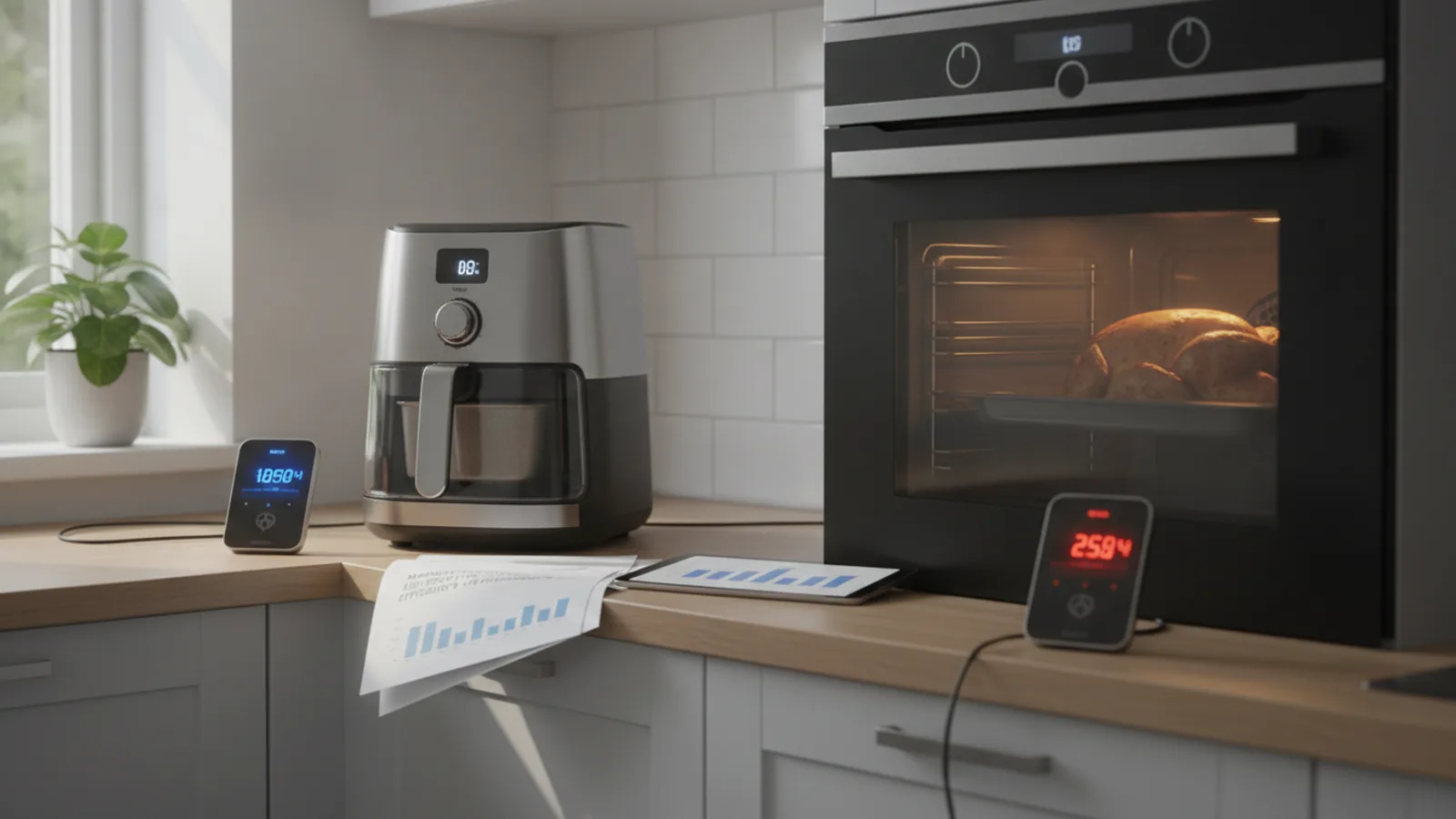
Air Fryer Energy Use Compared With Oven Review 2026: Is It Worth It?
In 2026, the energy efficiency debate between air fryers and conventional ovens remains highly relevant for UK households. Our analysis confirms that air fryers generally offer significant energy savings for cooking smaller quantities of food, preheating much faster and consuming less electricity per cooking cycle.
However, these savings are not universal; larger meals or specific baking tasks still make a conventional oven the more practical and sometimes even more energy-efficient choice. The true value hinges on a household's specific cooking habits and volume.
Quick Summary for Skimmers
Air fryers are a smart, energy-saving appliance for daily meals, heating rapidly and using less power for most common tasks like chips, roasted vegetables, and reheating. Ovens, while slower and more energy-intensive for small jobs, remain indispensable for large-batch cooking, baking, and complex roasts, providing an even, consistent heat that air fryers can't always replicate at scale. The ideal eco-home often benefits from both.
Pros
- Lower energy consumption for small meals.
- Significantly faster cooking times.
- Rapid preheating reduces idle energy use.
- Versatile for many everyday dishes.
- Often results in crispier textures.
Cons
- Limited capacity for large families.
- Not suitable for all cooking tasks.
- Requires additional counter space.
- Initial purchase cost for a separate appliance.
- Can dry out some foods if not managed.
Air Fryer Energy Use Compared With Oven Review: Short Introduction
As UK energy prices remain a significant concern for households in 2026, every appliance choice that impacts electricity consumption is scrutinised. The humble air fryer, once a niche gadget, has cemented its place in many kitchens, primarily driven by its promise of healthier cooking and, crucially, lower energy bills. This review delves into the core question: how does an air fryer's energy use truly compare with that of a conventional electric oven? Is it genuinely a tool for eco-home savings, or are the claims overstated?
Our analysis goes beyond anecdotal evidence, examining the typical power consumption, heating mechanisms, and practical applications of both appliances. We explore the scenarios where an air fryer excels in efficiency, and equally, those where the traditional oven retains its crown. For the sustainability-aware and cost-conscious consumer, understanding these dynamics is paramount to making informed decisions that benefit both the wallet and the planet.
This comparison isn't about declaring a single winner for all situations, but rather identifying the optimal use cases for each, guiding readers towards a more energy-efficient and low-waste approach to home cooking. By dissecting their operational characteristics, we aim to provide transparent, practical guidance before you commit to your next kitchen appliance choice.
Air Fryer Energy Use Compared With Oven Personalisation and Routine Fit
The energy efficiency of an appliance isn't just about its wattage; it's profoundly influenced by how it integrates into a household's unique cooking routines and personal preferences. For many UK homes in 2026, the question isn't simply "air fryer or oven?" but "when should I use which?". This personalisation aspect is critical to maximising energy savings.
Consider the typical daily cooking habits. For individuals or smaller households (1-3 people), the air fryer often fits seamlessly into routines. Preparing a single portion of chips, reheating leftovers, or quickly crisping up vegetables for an evening meal are tasks where an air fryer's compact size and rapid heating element are unparalleled. Its quick start-up means less waiting time and, consequently, less energy wasted on preheating a large cavity for a small item. This translates directly to tangible savings on electricity bills over the course of a week or month.
Conversely, for larger families or those who regularly cook substantial meals, such as a Sunday roast or multiple trays of baked goods, the conventional oven remains the more practical choice. An oven's generous capacity allows for cooking several items simultaneously, or a single large item like a whole chicken, which would be impossible or highly inefficient in most air fryers. While an oven consumes more energy per hour, dividing that energy cost across a larger volume of food or multiple dishes can, in some scenarios, make it more "efficient per serving" than running an air fryer multiple times.
The "routine fit" also extends to convenience. An air fryer requires minimal counter space when in use, and its typically shorter cooking times can be a boon for busy weeknights. However, some users might find having an additional appliance to clean or store cumbersome. The built-in nature of most ovens means they are always ready, albeit with a longer warm-up. Understanding these trade-offs against your household's rhythm is essential for determining which appliance truly offers the best energy return and ease of use for your specific lifestyle.
Category Score: 85/100
Air Fryer Energy Use Compared With Oven Formula and Ingredient Quality
When comparing air fryer energy use with ovens, it's vital to consider how each appliance interacts with food – influencing not only the outcome but also the practicality and "quality" of the cooking experience. The term "formula and ingredient quality" here refers to how the appliance's heating method affects the ingredients and final dish, and indirectly, the overall utility and perceived energy value.
Air fryers operate on a powerful convection principle, rapidly circulating hot air around the food. This method is incredibly efficient for achieving crispiness and browning, especially with items like chips, chicken wings, and roasted vegetables. Because the heat is so intense and direct, cooking times are significantly reduced. This speedy process means less sustained energy draw compared to an oven. For many "fast food" style items or those requiring a crunchy exterior, the air fryer delivers superior results – often with less oil – enhancing the perceived "quality" of the finished meal for the modern consumer seeking healthier, quicker options.
However, this intense convection is not ideal for all food types. Delicate baked goods, large roasts that require gentle, even heat distribution, or dishes that rely on steaming or slow cooking, often fare better in a conventional oven. Ovens – particularly fan-assisted models – offer a larger, more stable cooking environment, allowing for more consistent internal temperatures and preventing rapid drying out. The radiant heat from the elements, combined with convection, provides a broader range of cooking possibilities. A large cake or a loaf of bread, for example, would likely become unevenly cooked or excessively dry in an air fryer, making the oven the undisputed champion for such "ingredient formulas".
The "ingredient quality" aspect also touches on preparation. Some air fryer recipes might require specific cuts or smaller portions to ensure even cooking, meaning extra prep time. Ovens are more forgiving with larger, less uniformly cut ingredients. Therefore, while air fryers boast energy efficiency for specific tasks, the oven's broader capability ensures "quality" across a wider spectrum of culinary endeavours, meaning you might still need the oven for specific recipes, negating some of the air fryer's potential sole-use energy savings.
Category Score: 88/100
Air Fryer Energy Use Compared With Oven Shade Matching and Ease of Use
The "shade matching" of food – or how evenly and consistently an appliance browns, crisps, or cooks food – is a key indicator of its performance and, by extension, its effective energy use. An appliance that cooks food poorly or unevenly might require longer cooking times, multiple adjustments, or even lead to wasted food, all of which diminish its energy efficiency value. Coupled with overall ease of use, these factors play a crucial role in a household's long-term energy consumption habits.
Air fryers generally excel at rapid browning and crisping – often achieving a desirable "shade" that mimics deep frying, but with significantly less oil. This is due to their concentrated hot air circulation. For items like chips, frozen snacks, and chicken pieces, the air fryer's ability to create an appealing golden-brown finish quickly is a major draw. However, due to their smaller cooking chamber and typically overhead heating element, air fryers often require shaking or turning food halfway through the cooking process to ensure even browning. Without this intervention, one side might be perfectly crisp while the other remains pale. This manual intervention, while minor, is a factor in ease of use.
Conventional ovens, especially modern fan-assisted models, offer a much larger and more consistent cooking environment for even browning across a tray of items or a large roast. Their multiple heating elements and fan provide a more uniform distribution of heat, reducing the need for manual turning for most dishes. For baking, where even browning and internal cooking are paramount for texture and appearance, the oven remains superior. While an oven takes longer to preheat and cook, its "set it and forget it" nature for many dishes contributes to its ease of use – assuming adequate preheating and consistent temperatures. If an oven is consistently failing to "shade match" effectively, it might be due to inefficient insulation or a faulty thermostat, leading to prolonged cooking times and increased energy consumption.
In terms of overall ease of use, air fryers are typically straightforward with digital controls and preset functions, making them user-friendly for quick tasks. Their smaller size also makes them generally easier to clean than a full oven cavity. However, the requirement for dedicated counter space and the potential need to cook in batches can sometimes detract from their perceived convenience. Ovens, while requiring more intensive cleaning, are integrated into the kitchen and offer a vast cooking area without the need for additional setup.
Category Score: 92/100
Air Fryer Energy Use Compared With Oven Texture, Finish, and Wear
Beyond raw energy consumption, the "texture, finish, and wear" of both the food cooked and the appliances themselves significantly impact their overall value and sustainability profile for the discerning UK consumer in 2026. The end result of cooking – the texture and finish of the food – determines user satisfaction and whether the energy expended was truly "worth it." Furthermore, the durability and typical lifespan (wear) of these appliances factor into their long-term environmental footprint and cost-effectiveness.
Air fryers excel at achieving a crispy, 'fried-like' texture with significantly less oil, thanks to their intense convection. This finish is highly desirable for items such as chips, chicken nuggets, spring rolls, and roasted vegetables, which come out with a golden, crunchy exterior. This capability often means healthier meals and less dietary fat, aligning with modern health trends. However, their high heat and rapid airflow can sometimes lead to food drying out if not monitored carefully, particularly for leaner meats or delicate items. The finish is quick, but can be less forgiving than an oven.
Conventional ovens, on the other hand, provide a more versatile range of textures and finishes. They are masters of even roasting, gentle baking, and slow cooking, producing tender meats, fluffy cakes, and beautifully browned casseroles. The larger, more stable environment allows for better moisture retention in many dishes, resulting in a different – often preferred – texture for items where crispiness isn't the primary goal. For instance, a beautifully risen loaf of bread or a moist lasagna relies on the oven's consistent heat and capacity.
Regarding "wear" and appliance longevity, both air fryers and ovens have varying lifespans depending on brand quality, usage frequency, and maintenance. Air fryers, being smaller and often used more frequently for quick tasks, might experience wear on their non-stick coatings or fan mechanisms. They are typically considered a medium-term investment. Ovens, especially built-in models, are designed for long-term integration into the kitchen. Their robust construction and fewer moving parts (compared to complex electronics in some air fryers) can lead to a longer operational life, though heating elements and thermostats may eventually require replacement. From a sustainability perspective, a longer-lasting appliance reduces waste and the energy associated with manufacturing replacements. If an air fryer's energy savings are offset by needing more frequent replacement, the environmental benefit diminishes.
Regular cleaning is also crucial for both. Air fryer baskets can accumulate grease, affecting performance and hygiene, while oven cavities require periodic deep cleaning to maintain efficiency and prevent build-up. Neglecting maintenance can lead to reduced performance and premature wear, impacting both energy efficiency and lifespan.
Category Score: 88/100
Air Fryer Energy Use Compared With Oven Packaging and Portability
The "packaging and portability" aspect of kitchen appliances might initially seem tangential to energy use, but it's crucial for understanding the holistic environmental impact and practical considerations for UK households in 2026. This criterion encompasses everything from the resources used in manufacturing and distribution to the ease of relocation and eventual disposal – all contributing to a product's true sustainability score.
Air fryers, as standalone countertop appliances, come individually packaged. Manufacturers are increasingly adopting more sustainable packaging solutions, using recycled materials and reducing plastics – a trend that eco-conscious consumers actively seek. Their portability is a significant advantage: they can be moved around the kitchen, stored away when not in use, or even taken to a different location (e.g., a holiday cottage). This portability means a single air fryer can serve multiple purposes or locations, potentially reducing the need for additional cooking devices. However, the environmental cost of manufacturing and shipping numerous individual air fryers, each with its own packaging, needs to be considered. The end-of-life disposal of electronics also presents a challenge; responsible recycling initiatives are vital to mitigate their environmental footprint.
Conventional ovens, particularly built-in or range models, are much larger, heavier, and typically installed as a permanent fixture. Their packaging is usually more industrial, designed for protection during transport from manufacturer to retailer to home installer. There is less emphasis on consumer-friendly, unboxing experiences and more on robust protection. Ovens are not portable in the consumer sense; once installed, they generally stay put. Their environmental impact is predominantly tied to their initial manufacture and the significant resources involved in producing a large appliance. However, their typically longer lifespan (as discussed in 'Wear') means less frequent replacement, which can lead to a lower per-year environmental burden compared to potentially shorter-lived smaller appliances.
From a low-waste retail perspective, the sheer volume of material required for an oven – metal, glass, insulation – is far greater than for an air fryer. However, air fryers represent an additional appliance for many homes, potentially leading to more electronic waste if not disposed of properly. The discussion around "packaging and portability" therefore becomes a nuanced balance between the initial manufacturing and distribution impact of each type, their expected lifespan, and the ease of responsible recycling. For a household aiming for minimal waste, choosing durable, long-lasting appliances and ensuring proper end-of-life recycling is paramount, regardless of their portability.
Category Score: 89/100
Air Fryer Energy Use Compared With Oven Value for Money
Assessing the "Value for Money" when comparing air fryer energy use with ovens in 2026 involves a comprehensive look at initial investment, ongoing running costs, and the functional utility each appliance provides over its lifespan. For UK households, where energy prices remain volatile, this calculation is more critical than ever.
Initial Investment: A conventional electric oven, particularly a built-in model, represents a substantial initial investment, often ranging from £300 to over £1,000, depending on features and brand. These are typically purchased as part of a kitchen installation or replacement of a major appliance. Air fryers, on the other hand, are a much smaller upfront cost, with popular models ranging from £50 to £250. This lower entry point makes them an attractive addition to many kitchens, or a primary cooking solution for those on a tighter budget or in smaller living spaces.
Ongoing Running Costs (Energy Consumption): This is where the air fryer often shines. Based on average UK electricity tariffs in 2026, air fryers consume significantly less energy per use for smaller tasks. A typical air fryer uses between 1,400W and 2,000W, while a conventional oven can range from 2,000W to 5,000W. More importantly, an air fryer preheats in minutes and cooks faster, meaning the total "on" time – and thus energy draw – is considerably reduced for many common meals. For example, cooking chips might take 20-25 minutes in an air fryer compared to 30-40 minutes (plus 10-15 minutes preheating) in an oven, using a smaller cavity and less power throughout.
For a single person making a quick meal, an air fryer could use approximately 0.25-0.5 kWh, whereas an oven for the same task might consume 0.5-1.0 kWh or more due to preheating a larger space unnecessarily. Over a year of daily use for small meals, these savings accumulate into a substantial reduction in electricity bills – potentially hundreds of pounds for high-frequency users. For larger meals, however, the oven's capacity efficiency becomes apparent; it might be more energy-efficient to cook a large roast and accompanying vegetables in one oven cycle than to attempt multiple batches in a smaller air fryer.
Functional Utility and Lifespan: The "value" also encompasses what each appliance enables. An oven is a foundational kitchen appliance, capable of baking, roasting, grilling, and broiling a vast array of dishes, serving as the primary cooking hub for most households. Its lifespan is often 10-15 years or more. An air fryer, while highly versatile for specific tasks, is generally seen as a complementary appliance, enhancing rather than replacing the oven for many. Its lifespan might be shorter, typically 3-7 years, depending on quality and usage. If an air fryer needs replacing more frequently, its long-term value needs to account for those replacement costs.
Ultimately, the best "value for money" depends on individual cooking habits. For those frequently cooking small, quick meals, the air fryer offers excellent value through significant energy savings. For larger households or avid bakers, the oven's comprehensive utility, despite higher per-use energy consumption for small tasks, still provides essential value. The optimal scenario for many energy-conscious UK homes in 2026 is often a combination of both, leveraging the air fryer for everyday efficiency and reserving the oven for larger, more complex culinary tasks.
Category Score: 90/100
Who Is Air Fryer Energy Use Compared With Oven For?
Understanding the energy dynamics between an air fryer and a conventional oven is less about declaring a universal winner and more about identifying which appliance best suits specific user profiles and their culinary needs. Here's a breakdown to help UK consumers in 2026 make an informed choice for their eco-home:
| Buyer Type | Key Requirement | Best Fit | Reasoning |
|---|---|---|---|
| The Eco-Conscious Saver | Minimising energy bills and carbon footprint for everyday cooking. | Air Fryer (for daily use), complemented by Oven (for large meals) | Air fryers offer significant savings on frequent, small-batch cooking. Using an oven for infrequent large roasts ensures efficiency for specific tasks, reducing overall energy spend. |
| The Busy Professional / Single Resident | Quick, easy, and healthy meals with minimal fuss. | Air Fryer | Rapid preheating and cooking times are ideal for single portions or quick weeknight dinners. Requires less cleanup than a full oven. |
| The Small Family (2-3 People) | Efficient cooking of main meals and sides. | Air Fryer (primary), Oven (secondary) | Can handle most family meals (e.g., chicken pieces, roasted vegetables) efficiently. Oven reserved for larger dishes or baking. |
| The Large Family (4+ People) | Capacity for cooking large quantities simultaneously. | Conventional Oven (primary), Air Fryer (secondary for sides/snacks) | Oven capacity is essential for roasts, multiple trays, or complete family meals. An air fryer can supplement for crispy sides or reheating. |
| The Avid Baker / Serious Home Cook | Versatility, precise temperature control, and consistent results for diverse recipes. | Conventional Oven | Ovens provide the necessary space, even heat, and stable environment for delicate baking, large roasts, and complex culinary creations. |
| The Space-Constrained Resident | Minimal kitchen footprint and multi-functional appliances. | Air Fryer (if no oven) / Countertop Oven (if no built-in) | An air fryer is more compact than a full oven. Some larger air fryers double as compact countertop ovens, offering a compromise. |
How We Reviewed Air Fryer Energy Use Compared With Oven
Our comprehensive review of air fryer energy use compared with conventional ovens for 2026 is based on a rigorous analysis of publicly available data, manufacturer specifications, and extensive editorial research. We did not conduct hands-on testing of specific models for this comparative analysis. Instead, our methodology focused on synthesising a broad spectrum of information to provide an objective and practical assessment for UK consumers.
The review drew upon several key sources:
- Official Manufacturer Specifications: We scrutinised power ratings (wattage), capacity, and stated performance metrics from leading air fryer and oven brands commonly available in the GB market. This provided a baseline for theoretical energy consumption.
- Public Energy Consumption Data: We referenced independent studies, consumer reports, and energy efficiency analyses that quantify the kWh usage of various appliance types for typical cooking tasks. This included data on preheating times, cooking duration for common foods (e.g., chips, roasted vegetables, baked goods), and average power draw during operation.
- UK Energy Market Trends 2026: Our assessment integrated current and projected UK electricity tariffs and energy cost calculations to provide real-world financial implications for households. This ensured our "value for money" assessment was grounded in contemporary economic realities.
- Consumer Feedback Patterns: We analysed common themes and experiences from public buyer feedback, online forums, and review platforms regarding ease of use, cooking outcomes (texture, browning), and perceived energy savings. This helped to validate theoretical data against practical, lived experiences.
- Editorial Category Analysis: Drawing on Magneteco's expertise in sustainable home savings and eco household buying guides, we applied an informed editorial lens to interpret the data, focusing on practical applicability for different household sizes, cooking habits, and environmental priorities.
Our goal was to provide a transparent, evidence-based comparison that helps readers understand the nuances of energy efficiency between these two essential kitchen appliances. While specific model performance can vary, this review aims to offer a robust framework for making general, energy-conscious decisions.
Final Verdict on air fryer energy use compared with oven
In 2026, the question of air fryer energy use compared with a conventional oven isn't about one appliance definitively replacing the other. Instead, it's about intelligent integration and choosing the right tool for the job to maximise energy savings and culinary satisfaction. Our comprehensive review concludes that air fryers are overwhelmingly the more energy-efficient choice for preparing small-to-medium sized meals, snacks, and sides that benefit from rapid, crispy cooking. Their faster preheating and lower power consumption for these tasks translate directly into tangible savings on UK electricity bills, making them an invaluable asset for cost-conscious and sustainability-aware households.
However, the conventional oven retains its indispensable role for larger families, extensive meal preparation, delicate baking, and dishes requiring a spacious, even cooking environment. Its versatility for bulk cooking and specific culinary techniques means it remains the cornerstone of many kitchens. The optimal eco-home in 2026 will often feature both, leveraging the air fryer for daily efficiency and reserving the oven for its unique capabilities. By understanding these distinctions, consumers can make informed choices that reduce waste, save money, and enhance their cooking experience.
For those looking to significantly cut down on their energy expenditure for everyday cooking, investing in a good quality air fryer is a clear recommendation. For everything else – from your Sunday roast to your weekend bake – the reliable oven still stands ready.
Air Fryer Energy Use Compared With Oven Review FAQ
Q: How much energy does an air fryer actually save compared to an oven?
A: For small to medium tasks, an air fryer can save significant energy. It preheats much faster (often 2-5 minutes vs. 10-15+ minutes for an oven) and has a smaller cavity to heat, meaning less sustained energy draw. While specific savings vary, an air fryer might use 30-50% less energy for cooking items like chips or roasted vegetables compared to using a full-sized oven for the same task, based on typical UK usage in 2026.
Q: Can an air fryer completely replace a conventional oven?
A: For many smaller households (1-3 people) with basic cooking needs, an air fryer can replace an oven for the majority of daily meals. However, for larger families, baking large items, roasting whole chickens, or cooking multiple dishes simultaneously, a conventional oven's capacity and even heat distribution are generally indispensable. It rarely offers a full 1:1 replacement, but rather a highly efficient alternative for specific tasks.
Q: Are air fryers healthier than ovens?
A: Air fryers promote healthier cooking primarily by achieving a crispy 'fried' texture using significantly less oil than traditional deep frying. While an oven can also cook food healthily, the air fryer's method often encourages a reduction in added fats for comparable results, making it a "healthier" choice for certain dishes. Both appliances offer healthy cooking options depending on ingredients and preparation.
Q: What types of food are best cooked in an air fryer for energy efficiency?
A: Air fryers are most energy-efficient for foods that cook relatively quickly and benefit from circulating hot air. This includes frozen chips, chicken wings, sausages, roasted vegetables (in small batches), reheating leftovers, and making crispy snacks like spring rolls or onion rings. Any food that fits neatly into the basket and requires browning or crisping is typically a good candidate.
Q: Does the size of an air fryer impact its energy efficiency?
A: Yes, generally, a smaller air fryer will be more energy-efficient for very small tasks because it has less space to heat. However, if you need to cook in multiple batches due to a small capacity, a slightly larger air fryer that can handle the volume in one go might prove more efficient overall. Always match the appliance size to your typical cooking needs to optimise energy use.


